Identifying Nearby Jobs
When you create Appointments, you can easily identify Jobs at nearby locations that assigned Resources are qualified to complete. This enables you to group and combine planned work to optimize Resource efficiency. At dispatch, Service Board automatically performs a global search to find Jobs that are near newly scheduled or rescheduled Job locations, and calculates distances and scores. Nearby Jobs appear in the Job List with distance and Resource-match scores. You can then manually assign additional Jobs to Resources based on scores or distances.
 |
If your Service Board tenant is configured to use the default map provider to calculate travel times for Nearby Job recommendations, travel time information for nearby Jobs also appears on the Nearby Jobs List, and you can sort the list by travel times as well.
|
To identify nearby Jobs:
1. When you create an Appointment, and the following notification appears, click the link to view the Nearby Jobs List.

2. Review the Nearby Jobs List and assign Resources to additional Jobs as appropriate.
|
|
• In cases where travel time data for nearby Jobs is missing, an error message appears. You can then click Retry Travel Time Calculation at the top of the Nearby Jobs List or Retry on individual Job Cards to recalculate travel times.
• Travel times are cached in a single Nearby Job recommendation. After travel times for a specific Job are calculated, the data are not retrieved again until the next time you invoke the Nearby Jobs option.
|
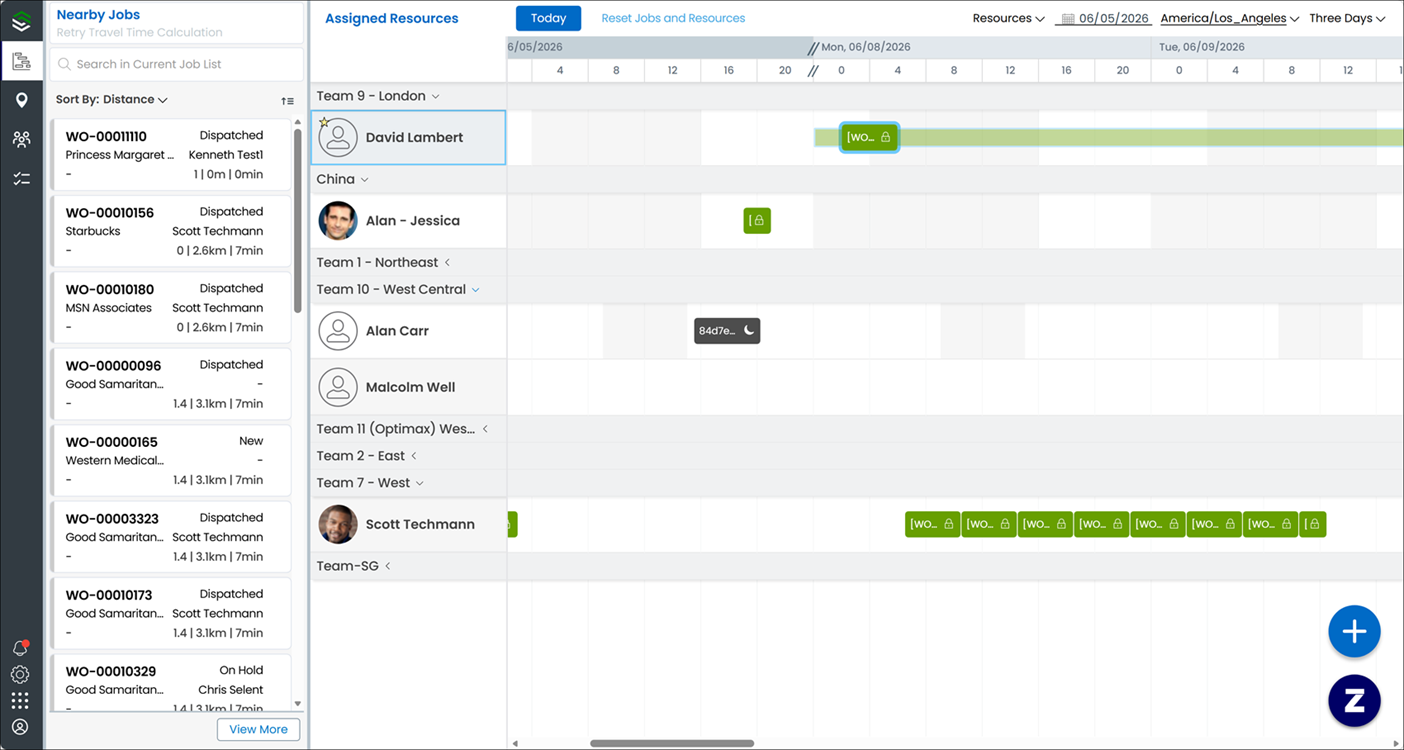
3. To return to the standard Scheduler view, in the Calendar, in the top left corner, click Reset Jobs and Resources.
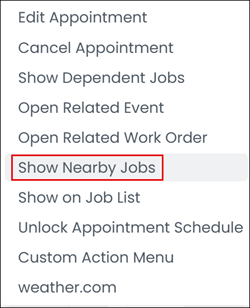
4. To find nearby Jobs for a specific Appointment, in the Calendar, click the Appointment, and then in the context menu, click Show Nearby Jobs.
5. To change the unit of measurement, click > > > , and then click the unit of measurement in which you want to view distance values.
Identifying Nearby Jobs in Classic Mode
| | The Classic user interface retires on November 8, 2026. All features are available in the Service Board Modern interface. We recommend switching to Service Board Modern at your earliest convenience to access the latest features. |
When you create Appointments, you can easily identify Jobs at nearby locations that assigned Resources are qualified to complete. This enables you to group and combine planned work to optimize Resource efficiency. At dispatch, Service Board automatically performs a global search to find Jobs that are near newly scheduled or rescheduled Job locations, and calculates distances and scores. Nearby Jobs appear in the Job List with distance and Resource-match scores. You can then manually assign additional Jobs to Resources based on scores or distances.
| | If your Service Board tenant is configured to use the default map provider to calculate travel times for Nearby Job recommendations, travel time information for nearby Jobs also appears on the Nearby Jobs List, and you can sort the list by travel times as well. |
To identify nearby Jobs:
1. When you create an Appointment, and the following notification appears, click the link to view the Nearby Jobs List.
2. Review the Nearby Jobs List and assign Resources to additional Jobs as appropriate.
| | • In cases where travel time data for nearby Jobs is missing, an error message appears. You can then click Retry Travel Time Calculation at the top of the Nearby Jobs List or Retry on individual Job Cards to recalculate travel times. • Travel times are cached in a single Nearby Job recommendation. After travel times for a specific Job are calculated, the data are not retrieved again until the next time you invoke the Nearby Jobs option. |
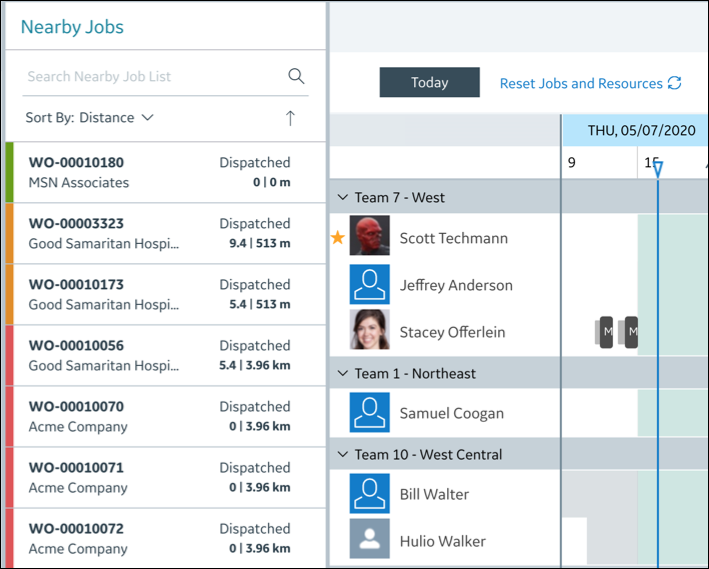
3. To return to the standard Scheduler view, in the Calendar, in the top left corner, click Reset Jobs and Resources.
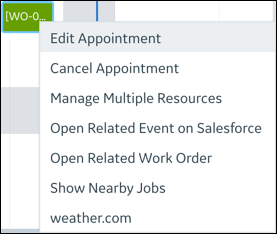
4. To find nearby Jobs for a specific Appointment, in the Calendar, click the Appointment, and then in the context menu, click Show Nearby Jobs.
5. To change the unit of measurement, click > > > , and then click the unit of measurement in which you want to view distance values.
Related Topics