Selecting Match Fields to Find Coverage
Use the Service Product and its Work Plans section to configure how the system identifies coverage for either a Service Contract or a Product Warranty. The system evaluates the appropriate coverage type based on the preference selected in the entitlement rule. Match fields determine which Service Contract or Warranty applies by comparing attributes such as Date, Account, Location, and Contact from the Work Order or Installed Product with corresponding fields on the coverage record. Correct configuration ensures accurate and consistent entitlement results.
After completing the General and Rule Settings sections in the Creating an Entitlement Rule for Service Contract and Warranty Coverage topic, configure the match fields in the Service Product and its Work Plans section to identify Service Contract or Warranty coverage.
To configure match fields for Service Contract or Warranty coverage:
1. On the selected entitlement rule record, scroll to the Service Product and its Work Plans section.
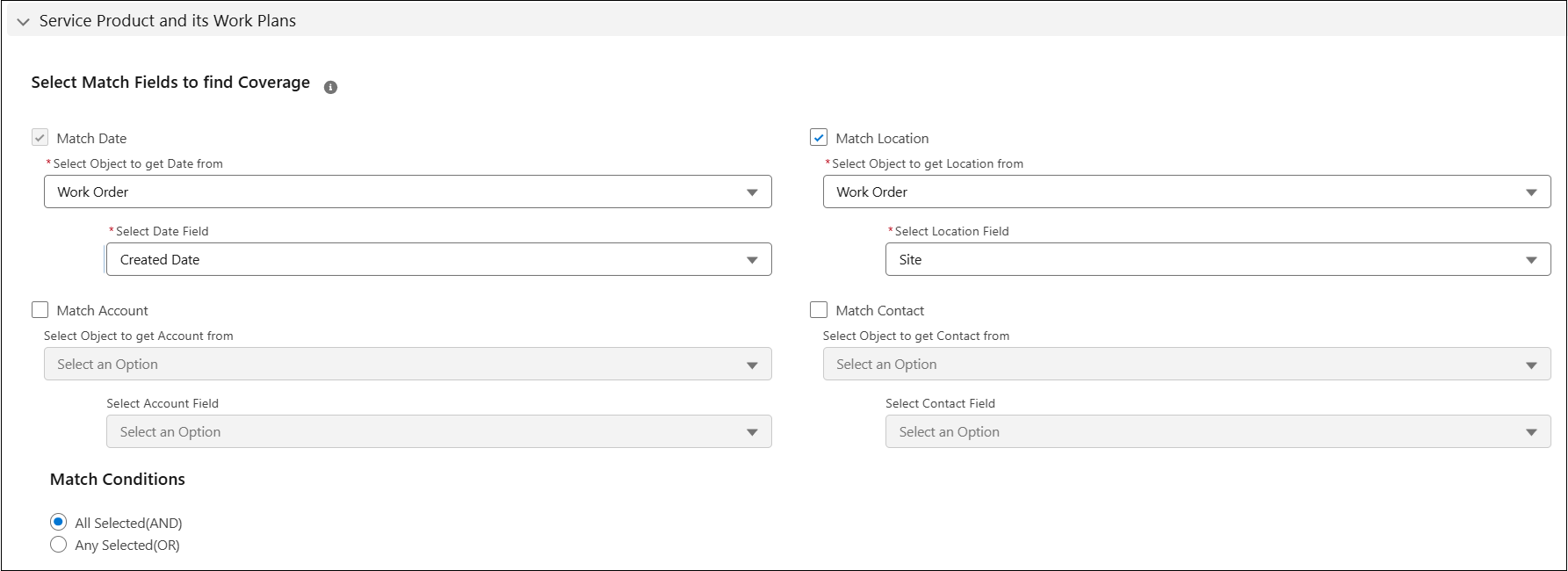
The following table describes the fields the entitlement engine uses to evaluate and match the applicable Service Contract or Warranty during coverage checks.
|
Field
|
Description
|
||
|---|---|---|---|
|
Match Date
Select the required Work Order’s or Installed Product’s Date field to check coverage. Based on the selection, the value in the Date field is compared with the Start Date and End Date of the Covered Product, Service Contract, or Product Warranty.
|
|||
|
Select Object to get Date from
|
Select the object from where you want to fetch the Date field to find matching warranty or service contract coverage. Available options are:
• Work Order: The Work Order’s Date field is compared with the Start Date and End Date of the Covered Product or Service Contract, or with the Start Date and End Date of the Product Warranty.
• Installed Product: The Installed Product’s Date field is compared with the Start Date and End Date of the Covered Product or Service Contract, or with the Start Date and End Date of the Product Warranty.
|
||
|
Select Date Field
|
Select the required date field from the selected object to find valid Service Contract records. For example, if the selected object is Work Order, then the date fields from the Work Order will be listed for selection. If Created Date is selected, the system considers Service Contract records whose Start Date and End Date include the Work Order’s Created Date for entitlement assignment.
|
||
|
Match Location
Select the required Location field of the Work Order or Installed Product to match with the Service Contract’s Covered Location.
|
|||
|
Select Object to get Location from
|
The Work Order’s or Installed Product’s Location field is matched with Service Contract’s Covered Location.
|
||
|
Select Location Field
|
Select the required Location field to match with Service Contract’s Covered Location. For example, if the Installed product’s and Service Contract’s covered location is Bangalore, and if the configured date falls within Covered Product’s or Service Contract’s Start Date and End Date, the engine displays the coverage during entitlement check.
|
||
|
Match Account
Select the required Account field of the Work Order or Installed Product to match with the Service Contract’s Account.
|
|||
|
Select Object to get Account from
|
Select the required object. The Account field from the Work Order or Installed Product is matched with the Account on the Service Contract.
|
||
|
Select Account Field
|
Select the required Account field to match with Service Contract’s Account. For example, if the Installed product’s and Service Contract’s Account is Global Hospital, and if the configured date falls within Covered Product’s or Service Contract’s Start Date and End Date, the engine displays the coverage during entitlement check.
|
||
|
Match Contact
Select the required Contact field of the Work Order or Installed Product to match with the Service Contract’s Contact.
|
|||
|
Select Object to get Contact from
|
Select the required object. The Contact field from the Work Order or Installed Product is matched with the Contact on the Service Contract.
|
||
|
Select Contact Field
|
Select the required Contact field to match with Service Contract’s Contact. For example, if the Installed product’s and Service Contract’s Contact is John Smith, and if the configured date falls within Covered Product’s or Service Contract’s Start Date and End Date, the engine displays the coverage during entitlement check.
|
||
|
Match Conditions
Use the Match Conditions settings to define how entitlement coverage is evaluated based on selected fields from a Work Order or Installed Product. The system checks for matches against the Service Contract or Covered Product using the following criteria:
• All Selected(AND): All configured match conditions (Date, Location, Account, Contact) must be satisfied for entitlement to be granted.
• Any Selected(OR): Entitlement is granted if at least one of the configured match conditions is satisfied.
|
|||
2. Scroll to the Ranking Contracts And Warranties section.
The following table describes the fields that determine how the entitlement engine selects the appropriate Service Contract or Warranty when multiple matches are found.
|
Field
|
Description
|
||
|---|---|---|---|
|
Ranking Contracts And Warranties
Displays options to define how multiple matching Service Contracts and Warranties are handled during entitlement checks.
|
|||
|
If multiple matches found
|
Select any of the following:
• Skip auto assignment: Select this option to skip the entitlement If multiple matches are found after the entitlement rule execution.
• Apply first match based on sort field: Select this option to apply first match based on the configured sort field.
If you select this option, configure the Select Field to Sort Service Contracts, Select Field to Sort Warranties, and Sort Order fields. For example, if Start Date is selected as the sort field and the sort order is Ascending, the system evaluates all matching Service Contracts and Warranties and selects the Service Contract or Warranty with the earliest Start Date as the eligible match. Depending on the preference set in the Rule Settings section, the system gives priority to either the Service Contract or the Warranty when both coverages are found during the entitlement check.
|
||

3. Scroll to the Select items to process in order from top until coverage is found section.
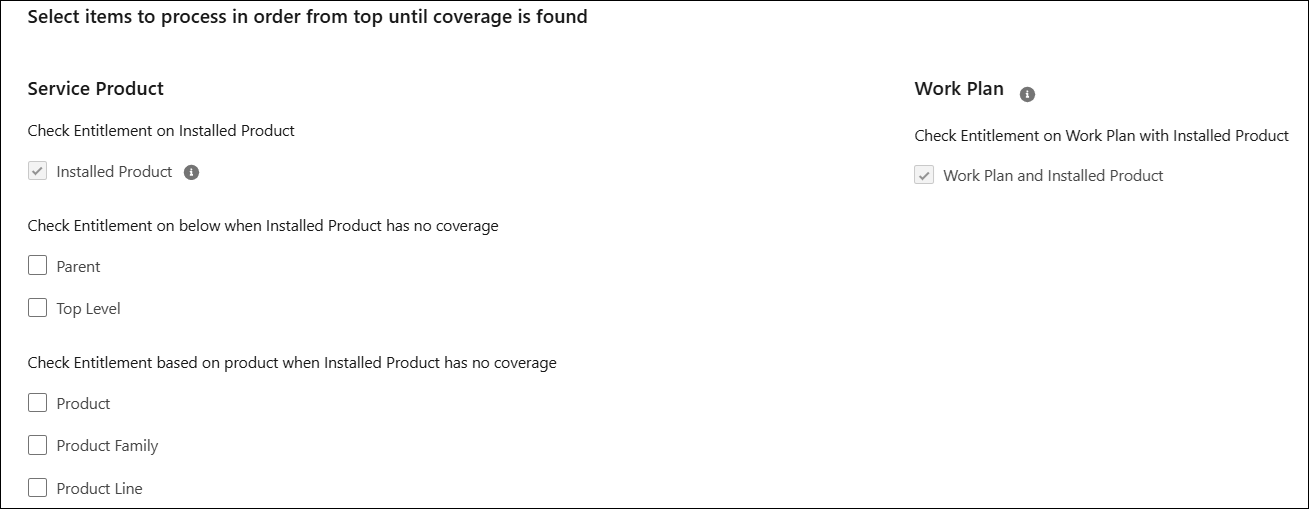
The following table describes the fields that define how the system evaluates Service Product and Work Plan levels in sequence to determine valid coverage.
|
Field
|
Description
|
||
|---|---|---|---|
|
Select items to process in order from top until coverage is found
Use this section to configure how the entitlement engine evaluates coverage across different levels of the Installed Product and associated Work Plan. The system checks the selected levels in order and stops when valid coverage is found. This helps ensure that the entitlement check runs efficiently, starting from the most specific level and moving upward only as needed. If coverage is not found at one level, the system continues to the next until a valid service contract or warranty is identified.
|
|||
|
Service Product
|
|||
|
Check Entitlement on Installed Product
|
The entitlement engine checks coverage for the Installed Product associated with the Service Product. This option is always selected and read-only. The system always checks coverage for the Installed Product linked to the Service Product first before evaluating other selected levels.
For Service Contract coverage, if coverage is not found at the Installed Product level, the system evaluates additional levels you select (such as Parent, Top-Level Component, Product, Product Family, and Product Line) in sequence until valid coverage is found.
For Warranty coverage, if coverage is not found at the Installed Product level, the system evaluates additional levels you select (Parent and Top Level) in sequence until valid coverage is found.
Example:
• For Service Contract coverage: The system first checks the Installed Product (preselected). If no coverage is found, it proceeds in sequence to the Parent and then to the Product Line, stopping when valid coverage is found.
• For Warranty coverage: The system first checks the Installed Product (preselected). If no coverage is found, it proceeds in sequence to the Parent and then to the Top Level, stopping when valid coverage is found.
|
||
|
Check Entitlement on below when Installed Product has no coverage
|
Select one or both of the following assembly levels to evaluate when coverage is not found at the Installed Product level: Parent and Top-Level Component. The system checks the selected levels in order and stops when coverage is found.
|
||
|
Check Entitlement based on product when Installed Product has no coverage
|
Select one or more product hierarchy levels to evaluate when coverage is not found at the Installed Product or its assembly levels. Available options include Product, Product Family, and Product Line. The system checks the selected levels in order and stops when valid coverage is found.
|
||
|
Work Plan
|
|||
|
Check Entitlement on Work Plan with Installed Product
|
This option evaluates Work Plan coverage associated with the Installed Product.
The system evaluates coverage for the Work Plan in the following fixed sequence until coverage is found. This is system default and cannot be modified:
• Installed Product and Work Plan
• Product and Work Plan
• Work Plan only
|
||
4. Click Save.
5. After configuring the Service Products and its work plans section, configure the Work Plans added directly to Work Orders section if applicable. For more information, see Configuring Work Plan Coverage for Work Orders.
 |
To skip entitlement checks on Work Plans added directly to the Work Order, leave the Work Plans added directly to Work Order section blank when configuring the rule. When you save the rule without configuring this section, the system displays a confirmation message. Select Confirm to proceed.
 |
Related Topics