Creating an Entitlement Rule for Service Contract and Warranty Coverage
You can create an entitlement rule for a Work Order that enables the system to display relevant Service Contract or Warranty coverage for Work Plans and Service Products. These rules are triggered when a user performs an entitlement check on a Service Product or Work Plan.
|
Prerequisite
|
|---|
|
Service Contract Prerequisites
Ensure that you add covered products and covered work plans to the appropriate Service Contract. Based on this, the entitlement engine retrieves the relevant Service Contract coverage during entitlement check. For more information, see Adding Covered Products and Adding Covered Work Plans.
Warranty prerequisites
• Ensure that each Service Product is linked to an Installed Product record.
• Warranty records must exist and be associated with Installed Products.
• Each Product Warranty must have clearly defined Start Date and End Date fields.
Based on this, the entitlement engine retrieves the relevant Warranty coverage during entitlement check. For more information, see Creating Warranty on Installed Product Automatically and Creating Warranty on Installed Product Manually.
|
In the entitlement rule, you can:
• Define qualifying criteria to apply the entitlement rule to only qualified Work Orders.
• Define conditions and configure date fields along with contact, account, or location fields for the Work Order or Installed Product object to enable entitlement on the Service Product and Work Plan for service contract coverage. However, even if you select date fields along with contact, account, or location fields, for warranty coverage only the date field is considered during the entitlement check.
 |
For service contract coverage, you must configure at least one matching field, Contact, Account, or Location, along with Date fields to run the rule and check coverage.
|
When Perform Auto Entitlement option is set to True on Service Product or Work Plan assignment records, the engine evaluates the rules in sequence and automatically assign the relevant service contract and warranty to the Service Product or Work Plan.
|
|
The system automatically sets the Perform Auto Entitlement flag based on the following Auto Assignment Rule settings:
• If Perform Entitlement Check When Work Plan is Assigned is enabled, the flag is set to True on the Work Plan Assignment record.
• If Perform Entitlement Check on Service Product if it is not entitled is enabled, the flag is set to True on the Service Product record.
For more information see, Auto-Assignment Rules.
|
Additionally, users can manually perform an entitlement check on a Service Product or Work Plan. The engine evaluates the rules in sequence and displays the relevant Service Contract or Warranty coverages.
For more information, see Entitlement Rule Execution Process.
To create an entitlement rule for Work Order to identify Service Contract or Warranty Coverage:
1. From the Home page, go to ServiceMax Setup > Work Plan Management > Entitlement Rules.
The Entitlement Rules page is displayed.
2. Click Add Rule.
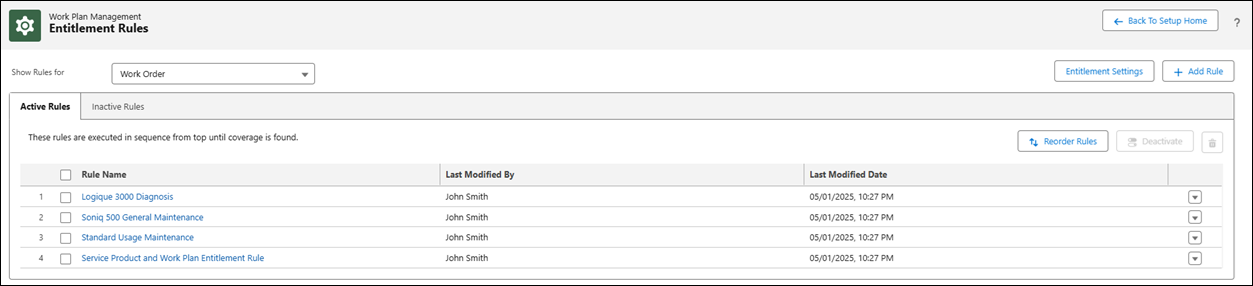
The New Rule for Work Order page is displayed.
3. In the General section, configure the fields as described in the following table:
|
Field
|
Description
|
||
|---|---|---|---|
|
General
|
|||
|
Rule Name
|
Displays the name of the rule used to identify it uniquely. Enter a unique name for the rule.
|
||
|
Developer Name
|
Displays the developer name, auto-populated based on the rule name. You can also manually enter a unique developer name if required.
|
||
|
Rule Description
|
Displays a brief description of the rule’s purpose. Enter a meaningful description for the rule.
|
||
|
Rule for Object
|
Displays the object to which the rule is applied. By default, Work Order is selected.
|
||
|
Qualifying Criteria
|
Displays the criteria that determine which Work Orders the rule applies to. Select a criteria from the drop-down to apply this rule only to qualified Work Orders If this field is left blank, the entitlement rule is applied for all work orders when a user performs an entitlement check on an associated work plan or service product.
|
||
|
Rule Active
|
Displays the activation status of the rule. Enable the checkbox to activate the rule for execution.
|
||
|
Rule Settings
|
|||
|
For entitlement check, consider this
|
Displays the type of coverage to be evaluated during the entitlement check. Select Service Contract and Warranty to evaluate both coverage types during the entitlement check.
|
||
|
Preference when matching Service Contracts and Warranties are found
|
Specifies which coverage type takes precedence when both Service Contract and Warranty matches are found during the entitlement check. From the dropdown, select Service Contract or Warranty to define which coverage the system should apply first when both are available.
|
||
4. In the Rule Settings section, under For entitlement check, consider this, select Service Contract and Warranty to specify that the entitlement check is based on service contract and warranty coverages.
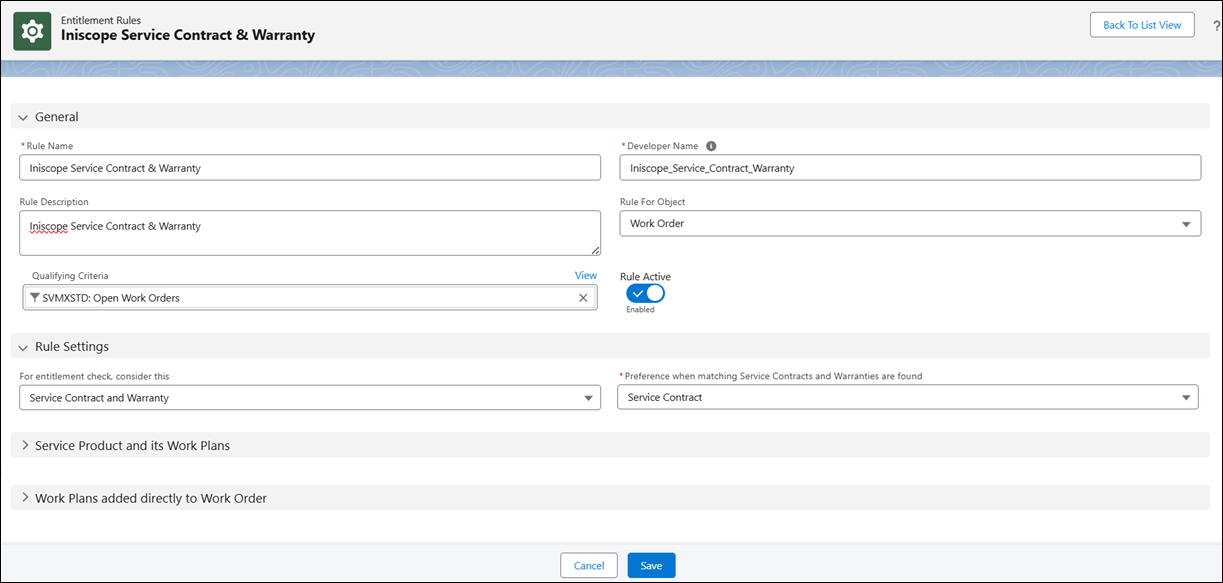
5. The configuration under the Service Product and its Work Plans section in the rule enables system to perform entitlement check on the service product and its work plan.
For more information about configuring Service Product and its Work Plans, see Selecting Match Fields to Find Coverage.
6. The configuration under the Work Plans added directly to Work Order section in the rule enables system to perform entitlement check on Work Plans that are added directly to the Work Order and not linked to any Service Product.
|
|
The warranty-based entitlement check is not performed for Work Plans that are added directly to a Work Order.
|
For more information about configuring Work Plans added directly to Work Order, see Configuring Work Plan Coverage for Work Orders.
7. After configuring the entitlement rule, click Save.
|
|
If you save the entitlement rule without configuring the Work Plans Added Directly to Work Order section, the system displays a confirmation message. Select Confirm to proceed.
 |
Related Topics