Adding Dictionary Items in a Work Order
Add Observations, Root Causes, or Solutions to an Investigation directly from a Work Order so Remote Service Engineers can record findings, diagnoses, and resolutions for the selected Installed Product as part of the service history.
You can add new Observations, Root Causes, or Solutions to an Investigation while working on a Work Order. Adding dictionary items allows Remote Service Engineers (RSEs) to record findings, diagnoses, and resolutions directly in the Investigations widget, ensuring all entries are linked to the correct Installed Product and stored as part of the service history.
To add dictionary items:
1. Locate the Work Order by searching in the sidebar or selecting it from the Work Orders tab, and then click the Work Order number to open it.
The selected Work Order is displayed.
2. Select the Investigations tab.
3. From the Installed Product drop down list, select the relevant installed product.
 |
• The Installed Product dropdown appears only when the Work Order is associated with multiple Installed Products.
• The dropdown defaults to the first Installed Product in the list.
• If only one Installed Product exists, its name appears as a label instead of a dropdown.
• Changing the Installed Product switches to an existing Investigation for that product or creates a new one. It does not modify the current Investigation.
|
4. In the Observations, Root Causes, or Solutions section, enter a keyword in the search box and select the appropriate item from the results. The selected item is automatically added to the Investigation and appears in the corresponding list.
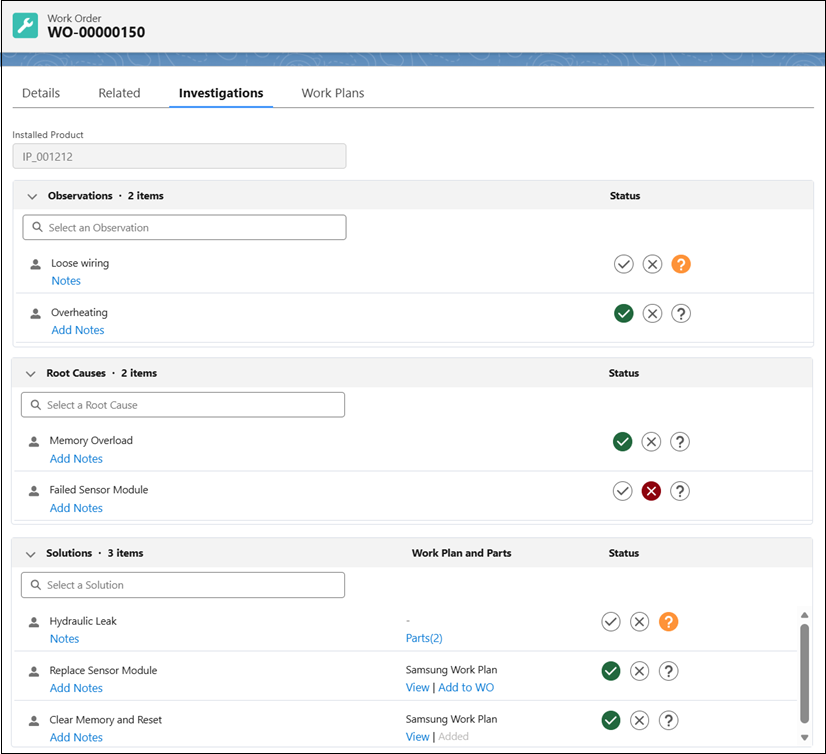
|
|
• You can add only one item at a time.
• Only items applicable to the selected Installed Product are displayed.
• Newly added items appear at the top of their respective sections (Observations, Root Causes, or Solutions).
• Dictionary items already added to the investigation appear disabled in the dropdown and display a checkmark. Hover over the disabled item to view the tooltip Already added to the table. Selecting the item does not add it again.
|
Each item displays the following information:
◦ Item name: The name of the Observation, Root Cause, or Solution selected from the dictionary.
◦ Status icon (✓, ✗, ?): The status icon reflects the current state of the dictionary item. Hovering over the icon shows its status label (for example, Confirmed). Each investigation item shows a Status icon for quick identification. For information about the status indicators displayed on each item, see Dictionary Item Status Indicators.
◦ Origin icon (person or robot): A person icon represents a human-entered item, and a robot icon indicates an AI-suggested item. Hovering over the icon displays a tooltip showing the most recent editor�s name and the timestamp of the update in your local time zone.
|
|
If no investigation data exists, the widget displays empty sections for Observations, Root Causes, and Solutions.
|
Each section header (Observations, Root Causes, and Solutions) displays a count (for example, 2 items). This count updates automatically as items are added or removed from the Investigation.
5. When you add a Solution, the system checks whether it is linked to a Work Plan. If a Work Plan exists, its title appears in the Work Plan and Parts column. Click View to open it in a new browser tab, or click Add to WO to include it in the current Work Order under the relevant Solution.
When you click Add to WO, the system displays a confirmation message indicating that the Work Plan has been added. The link then changes to Added , confirming that the Work Plan is now associated with the Work Order.
|
|
• Removing a Solution does not remove its Work Plan from the Work Order.
• Work Plan functionality is only available for Investigations in a Work Order, not in a Case or Service Request.
• If the same Work Plan is already linked to the Work Order (either under General Tasks or the current Service Product), the Add to WO option is disabled.
• Removing a Solution does not remove its associated Work Plan from the Work Order. You must remove it manually if needed.
• A Solution can have only one Work Plan, but a single Work Plan can be linked to multiple Solutions.
|
The selected dictionary items are saved automatically and become part of the Work Order’s Investigation record.
6. If a Solution does not include a Work Plan, parts can be managed to capture the components required for the resolution.
For more information, see Parts Management for Investigation Solutions.
|
|
You can add notes to any dictionary item to capture additional details, context, or follow-up information. For more information, see Notes on Dictionary Items.
|
Related Topics