Module Parameters
This section explain about the settings for the Acoustics module.
Click Acoustic under Physics Module. The acoustic parameters to be specified in the Properties Panel are as follows:
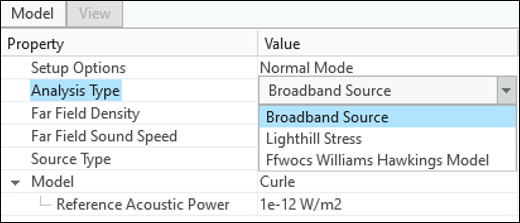
• Analysis type— Three analysis types of Acoustic model are available in Creo Flow Analysis. They are Broadband Source, Lighthill Stress, and Ffwocs Williams Hawkings Model, as shown in the following figure.
Figure 12. Types of Acoustic analysis
• Far Field Density— Far Field Density is the fluid density in the region faraway from the source.
• Far Field Sound Speed— Far Field Sound Speed is the sound speed in the region faraway from the source.
Broadband Source
It aims to model the sources of sound, but not the sound propagated to the receivers, such as a microphone or an ear. Broadband noise is assumed to have a continuous spectrum with the acoustic power distributed at several different frequencies. These models can predict the strength of sources of noise due to effects, such as turbulent boundary layer flow or turbulent mixing. The broadband noise source models are available for both steady and transient simulations.
The additional options that are available for the broadband source model are:
• Source Type— The Source Type can be either Surface or Volume, as shown in the following figure.
Figure 13. Source Type
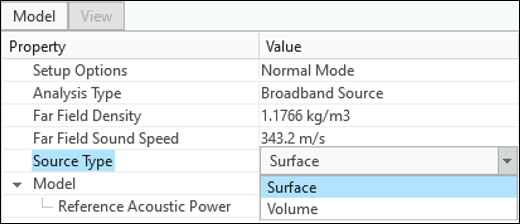
◦ Surface— This option enables the user to select a surface boundary as the source.
◦ Volume— This option enables the user to select a volume as the source.
• Model
— The model depends on the type of source selected. The options available under Model drop-down list are:
◦ Curle— This model is available only for the Surface Source Type. This is a broadband source model for the noise generated by the turbulent shear layer. The model computes the surface acoustic power and depends on the solver variables from the Flow and Turbulence modules.
◦ Scaling Law— This model is used with Surface and Volume Source Type. The model uses a distribution of sources to approximate the acoustic power generated by turbulent fluctuations in the flow. These sources are calculated based on the turbulent energy and dissipation fields obtained from a Flow simulation.
◦ Proudman— This model is available only for the Volume Source Type. It computes the acoustic power in the volumes containing the noise sources; such as areas around fan blades, turbulent mixed flows in ducts, heat exchangers etc. The acoustic power is function of turbulence kinetic energy, turbulence dissipation rate, density and speed of sound.
Model for Surface source 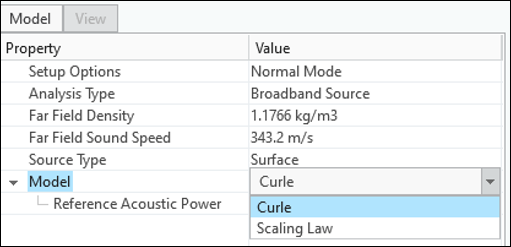 | Model for Volume source 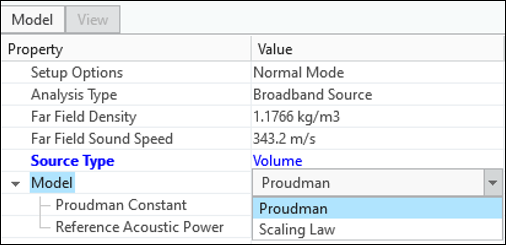 |
Lighthill Stress
Lighthill's equation is a form of the inhomogeneus wave equation that describes the propagation of sound waves in a fluid flow. Lighthill stress is a measure of the acoustic sources in a fluid flow, which are primarily due to turbulence. It represents the force that the fluid exerts on the surrounding medium, which produces sound waves, and is the source term in Lighthill’s equation. The present model enables viewing of the Lighthill stresses on the fluid domain, thereby enabling identification of the sources.
The additional parameter to be specified under this analysis is:
• Far Field Pressure— It is the pressure in the region faraway from the source.
Ffowcs-Williams Hawkings (FWH) Model
This model computes the propagation of sound from source to the receivers. Hence, it can be used for the comparisons with experimental data. This model is applicable only for the transient simulations. It has option to provide both boundary and volume source.
The additional parameter to be specified under this analysis is: Far Field Pressure.