ServiceMax AI Architecture
ServiceMax AI uses a centralized console, specialized agents, and configurable actions to automate service workflows across ServiceMax applications. It is an AI-powered assistant that helps technicians and service teams retrieve information, generate summaries, and run guided tasks in the ServiceMax platform.
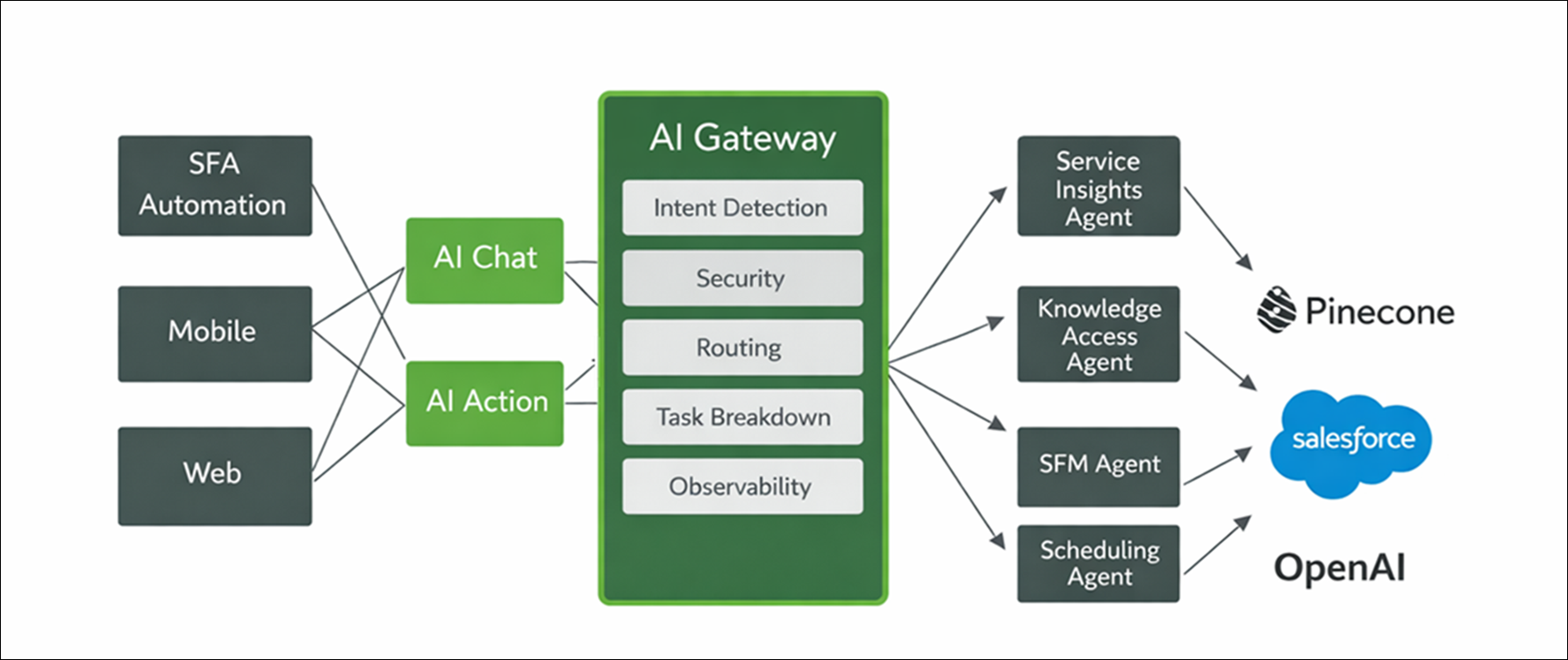
ServiceMax AI uses an agent‑based architecture to process user requests across multiple channels. The architecture separates user interaction, decision‑making, and execution. This design improves security, scalability, and accuracy.
End users interact with AI through chat or actions. The system then routes each request to the correct AI agent based on intent.
The architecture consists of four main layers:
• Interaction channels
• AI interaction layer
• AI Gateway
• Specialized AI agents
Interaction Channels
ServiceMax AI supports multiple entry points:
• SFA Automation — Triggers AI requests from system‑driven and workflow‑based events.
• Mobile applications — Enables technicians and users to interact with AI while working in the field
• Web applications — Supports AI interactions from browser‑based user experiences
These channels capture user input and system events. They do not contain business logic.
AI Interaction Layer
The AI interaction layer exposes two modes:
• AI Chat — Supports conversational user interactions.
• AI Action — Supports task-based and automated operations.
Both modes send requests to the same orchestration layer.
AI Gateway
The AI Gateway is the central control layer. All AI requests pass through this gateway. The gateway performs the following functions:
• Intent detection — Identifies what the user is trying to do.
• Security — Enforces access control and safety checks.
• Routing — Selects the appropriate AI agent.
• Task breakdown — Splits complex requests into smaller tasks.
• Observability — Tracks execution and system behavior.
The AI Gateway does not execute business logic. It only coordinates execution.
Specialized AI Agents
After routing, the gateway delegates work to domain‑specific agents.
Each agent handles a focused capability:
• Service Insights Agent — Analyzes service data and generates insights.
• Knowledge Access Agent — Retrieves relevant knowledge using semantic search.
• SFM Agent — Performs ServiceMax Field Service Management operations.
• Troubleshooting Agent — Analyzes historical service data and resolved work orders to surface similar issues and actionable troubleshooting guidance for active work orders.
• Scheduling Agent — Handles scheduling‑related tasks.
Agents operate independently and do not communicate directly with channels.
External systems and AI services
AI agents integrate with external platforms as required:
• Pinecone for semantic and vector search
• Salesforce for CRM and field service data
• OpenAI for foundational AI model capabilities
These integrations are abstracted behind agents to reduce system coupling.
ServiceMax AI Request Flow
A ServiceMax AI request starts from a supported channel such as SFA Automation, Mobile, or Web and enters the system through AI Chat or AI Action. The request then passes to the AI Gateway, which detects intent, applies security checks, breaks down complex tasks, and routes the request to the appropriate specialized AI agent. The selected agent executes the request and, when required, interacts with external systems such as Salesforce, Pinecone, or OpenAI. The agent returns the result to the AI Gateway, which records execution details and sends a consistent response back to the originating channel.
ServiceMax AI Access
End users can access ServiceMax AI through supported surfaces such as the Go app, Salesforce web, and Zinc. Administrators use the AI Console to configure and validate behavior.
Related Topics