Vector Analysis
The following figure shows the spigot in a general position. P1 through P8 are vectors originating at the origin. To keep the drawing simple, the line from the origin is shown only for P1. The vectors derived from the spigot dimensions are also shown:
Spigot—General Dimensions
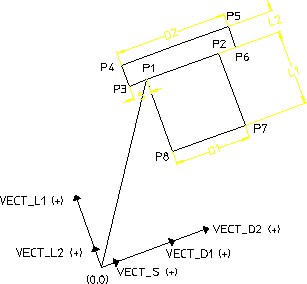
Dimensions such as D1 and L1 (refer to Figure 10) cannot be used in vector analysis: vectors need a direction as well as a length. However, it is simple to convert dimensions to vectors if the angles are known or can be calculated.
Let's take the dimension S first. The angle at which S acts is the same as the angle of (P2-P1). Since P2 and P1 are vectors, the angle of the vector (P2-P1) can be calculated from ANG(P2-P1). ANG is a built-in function.
If we say that the vector derived from S is called Vect_S, then:
Vect_S = (PNT_RA S ANG(P2_P1))
where PNT_RA is a built-in function that converts a length and an angle to a vector.
To convert L1 and L2 to vectors, note that the angle will be 90 degrees greater than the angle of (P2-P1). For example:
Vect_L1 = (PNT_RA L1 (ANG(P2-P1)+90))
The other vectors are defined in a similar way. Note that in Figure 10, the vectors representing the dimensions are all positive in the directions shown. In Figure 10 we drew the spigot in any arbitrary position. This means that, in many positions, the vectors of the dimensions will actually be negative. This does not matter. As long as you use a consistent "sign convention", you do not need to worry about the sign of a vector.