Replication Disowning Behavior for Local Strong-side and Weak-side Replicated Links
When a user initiates the replication disowning process for an object, the system gathers its dependent objects. By default, this includes items such as version history, CAD files, and change records. For a complete list of collected objects, see Dependent Objects Included in Replication Disowning.
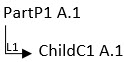
In the above scenario, PartP1 A.1, ChildC1 A.1, and Link L1 are replicated from the source system. Since Link L1 originates from PartP1 A.1, this object is considered the strong side of the link. Conversely, ChildC1 A.1, where the link terminates, is on the weak side.
If a replicated object on the strong side is selected for disowning, any links originating from it are converted to local links. However, if the object is on the weak side, the links remain replicated.
For example: If PartP1 A.1 is disowned, both the part and Link L1 are converted to local objects. However, if only ChildC1 A.1 is disowned, then only that object becomes local, while Link L1 remains a replicated link.
Additionally, if a replicated object has missing dependencies in the target system, converting it to local will remove references to those missing objects.
 |
The user must have the necessary access rights to the link in order to convert replicated data into local data. Without this access, the replication disowning process will not succeed.
|