Setting Variance Effectivity
You can perform the following actions on a variance effectivity:
• Display empty (unassigned) variance effectivities
• Create new variance effectivities
• Remove variance effectivities
• Other editing actions such as Copy, Set Attributes, Set Effectivity Context, and Set Effectivity Type.
 |
Ensure that the Variance Effectivity preference is set to Yes. If it is set to No, the Set Effectivity and View Effectivity options are hidden, preventing you from creating a variance effectivity.
|
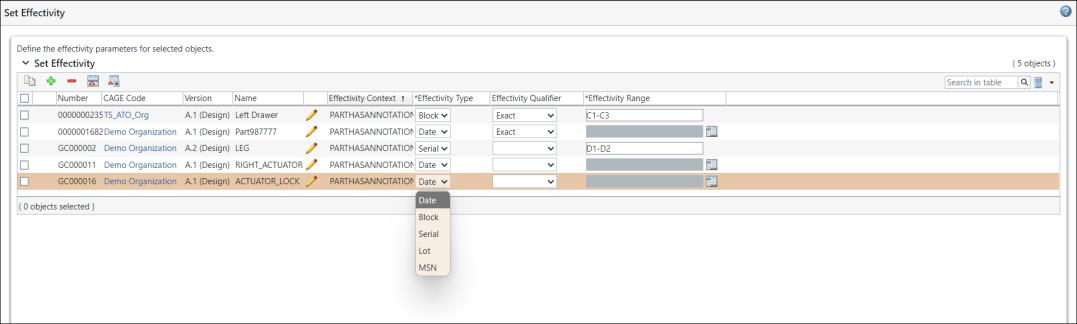
Displaying Default Variance Effectivities
An empty (unassigned) variance effectivity is displayed when no pre-existing variance effectivity exists for an affected object on a variance. In this case, the Default Variance Effectivity preference is set to None. A date variance effectivity is displayed when the preference is set to Date.
Creating New Variance Effectivities
The Create Effectivity  action creates a new variance effectivity for the selected affected object. A new variance effectivity row is created for the selected (seed) affected object. You can use the Create Effectivity action without selecting any object. In this case, a new variance effectivity will be created for all selected affected objects in a variance.
action creates a new variance effectivity for the selected affected object. A new variance effectivity row is created for the selected (seed) affected object. You can use the Create Effectivity action without selecting any object. In this case, a new variance effectivity will be created for all selected affected objects in a variance.| | If multiple rows are selected for the same seed object, the Create Effectivity action adds only one variance effectivity. |
Removal of Variance Effectivities
The Remove Selected Object action  removes the real and empty (unassigned) variance effectivity rows. Additionally, when you click Finish, the empty (unassigned) variance effectivity rows are deleted automatically.
removes the real and empty (unassigned) variance effectivity rows. Additionally, when you click Finish, the empty (unassigned) variance effectivity rows are deleted automatically.Other Editing Actions
Editing actions such as Copy and Add Effectivity, Set Effectivity Attributes, and Set Effectivity Type are not supported for the empty (unassigned) Effectivity Type rows. If you want to perform any of these actions, clear the empty Effectivity Type row and try again.