Change Process Flexibility by Configuring Implementation States on a Change Notice
A type manager property Implementation States is added on the change notice type in the Type and Attribute Management utility.
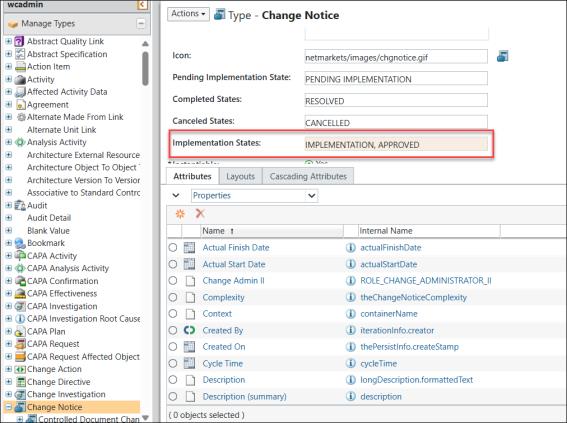
Administrators can now configure multiple implementation state values for change notices using a newly introduced property. To add multiple implementation states, enter comma-separated values for this property. For example: Approved, Post Release. This enhancement provides greater flexibility and control in managing change notice workflows. This new capability replaces the existing preference Change Implementation State Definition, which was used to define the Implementation state.
 | The existing preference Change Implementation State Definition, which was used to define Implementation state, is deprecated and will be removed in a future release of Windchill. After upgrading to Windchill 13.1.2, the Implementation States type manager property initially appears blank. The value is then determined by the Change Implementation State Definition preference and will continue to be used until values are explicitly configured in the Type Manager. For new Windchill systems, the default implementation state is set to Implementation. |
Following are the key features of the enhanced change process flexibility:
• Change tasks can no longer be created directly from the Implementation Plan table when the change notice is in an Implementation stage.
• To add new change tasks during this stage, use the Edit page, which ensures that stage and sequence restrictions are properly enforced.
• You can now select and delete multiple change tasks directly from the Implementation Plan table.
This is especially useful when working with overloaded change notice templates, allowing for quick removal of unnecessary tasks.
Adding a New Implementation State
You can add a new implementation state to the enumeration States (wt.lifecycle.StateRB) using Custom Modeled Enumerations. For more information, see Creating a New Enumeration Entry.
Related Topics