Route the Package
Routing Overview
Routing assigns tasks to team members for adding, reviewing, and approving package contents.
Email notifications are sent to:
• Assignees for task action.
• Package creator for tracking progress.
The package creator can also force-approve a task if needed. This removes the task from the assignee’s list and completes the routing. Notifications are also sent when a task is completed or fails.
Steps to Route a Package
To route a package, do the following:
1. In the Route window, under Select Routing Process, select Dependency Evaluation and Locking for Participation in Replication Routing for Object Collector Package or Dependency Evaluation and Locking for Participation in Replication Routing for Context Collector Package to route the package for the In-transit lock. If required, you may select other routing process options before routing the package for the In-transit lock.
Available routing process options include:
◦ Content Routing for Object Collector Package or Content Routing for Context Collector Package: Assigns contributors the task of adding content to the routed package.
◦ Approval Routing for Object Collector Package or Approval Routing for Context Collector Package: Assigns reviewers and approvers a task to review and approve the contents of the routed package, respectively. The review task is optional in the routing process. When routed for approval, the package moves to the Under Review state.
◦ Dependency Evaluation and Locking for Participation in Replication Routing for Object Collector Packageor Dependency Evaluation and Locking for Participation in Replication Routing for Context Collector Package: Collect the dependents of the selected objects in the package, and assign tasks to reviewers and approvers to review and approve the summary reports that are generated during the routing process. The review task is optional in this process. You must be a member of the Replication Authority group to route the package for dependency review. The package transitions from the Evaluation state when collecting the dependents, and then to the Summary and Review state.
 |
In this document, both the routing options Dependency Evaluation and Locking for Participation in Replication Routing for Object Collector Package and Dependency Evaluation and Locking for Participation in Replication Routing for Context Collector Package are collectively referred to as dependency review routing.
|
2. In Define Distribution List, select the participants who will be assigned tasks for adding content, reviewing, or approving the package or its summary reports. To perform these actions on a Context Collector Package, participants must be members of the Replication Package Administrators group. Additionally, reviewers and approvers involved in the dependency review routing process must also belong to the Replication Authority group.
3. (Optional) Perform the following steps:
◦ Specify Instructions: You can provide notes or special instructions.
◦ Specify Due Date: You can enter a duration for the routing activity or click the calendar to select a due date.
◦ External Participants: Yo can choose to notify additional participants who were not included in the Define Distribution List.
4. Click Finish to initiate the routing process.
Routing Outcomes
If the dependency review routing action is successful, the in-transit lock, named In Transit for Replication, is applied to the selected and dependent objects in the package and to the selected and dependent objects. You cannot perform any modification action on such objects until the lock is released.
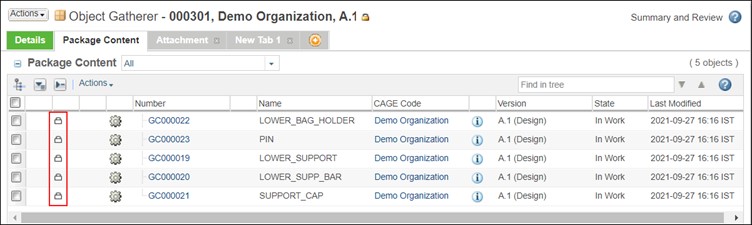
For more information, see Removing the Replication Lock.
If the dependency review routing action fails, the in-transit lock is not applied to the objects in the package. The package moves to the Failed state.
The route action fails in the following circumstances:
• None of the objects in the package is eligible for the in-transit lock. For example, electrical parts, managed baseline, or objects not supported for replication.
• All the objects in the package are already replicated.
• The package does not contain any object.
• An error or exception occurred when collecting the dependent objects.
If any of the objects in the package are eligible for the in-transit lock, the process does not fail and the lock is applied to the eligible object. Summary reports are generated for the routed package where you can check which objects are eligible for replication or if there are any violators that are preventing the in-transit lock from being applied. In case of a violation, the package moves to the Reworkstate.
For more information, see Replication Summary Reports.