Business Identity for Objects
In Windchill, business identity is a collection of specific attributes that uniquely identify an object (like a part, document, and so on) across different systems or contexts. These attributes are used to:
• Match objects during replication.
• Determine whether an object should be updated, skipped, or linked.
• Ensure consistency between source and target systems.
The attributes that make up the business identity vary depending on the object type.
|
Object Type
|
Business Identity Attributes
|
|---|---|
|
Part
|
Number, revision, iteration, and organization ID or CAGE code
|
|
Document
|
Name, number, version, iteration, and organization ID or CAGE code
|
|
EPM Document
|
CAD file name, authoring application, document category, document number, version, and organization ID or CAGE code
|
|
Change Object
|
Number, revision, and organization ID or CAGE code
|
Business identity information is generated for the weak side of an object under the following conditions:
• The object is marked as a placeholder.
• The object is included only in a replication package type.
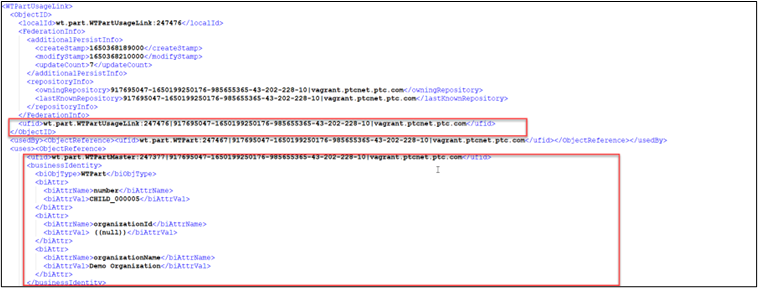
This business identity information is generated during the creation of a replication package and is stored in the Link.xml file. This file is created for each association link between strong-side and weak-side objects and can be found in the METADATA folder within the zipped package.
For example, in the case of a part usage link, the Link.xml file displays the number, organization ID, and organization name as the business identity of the weak-side object.
 |
The business identity information is not displayed if you do not have access to the weak-side object.
|
When a local object on the target system is marked with a replication lock, the system identifies it using the business identity received by the source system. This process includes appropriate mapping and version label handling.
The different conditions or outcomes in the replication process are as follows:
• If the version matches, the object is converted into a remote object by applying the universal federated identity from the source system, and then it is overwritten.
• If the business identity of the source and target objects do not match, the object is not replicated. The replication lock remains unchanged on the target system.
• If the business identity of the source and target objects match and the objects are overwritten, the replication lock on all the versions of the object is converted to a product design lock.