Example: Heat Flow on a Square Plate - II
Solve for the steady-state temperature distribution of a square plate using the partial differential equation solver relax.
Solving Poisson's Equation
Solve the heat equation where values of the source function are known and the boundary conditions are non-zero.
|
|
The relax function is based on an entirely different solving method, and hence requires a different set of arguments.
|
1. Define five square matrices a, b, c, d, and e to contain the coefficients for the Laplacian approximation:

|
|
These arrays can be of any size you specify. The larger they are, the finer the mesh in the solution.
|
2. Define the dimension of the square plate:


3. Define the coefficients:


4. Define the strength and position of a constant source.

5. Define a square matrix f, of size equal to the size of the grid, to contain the known boundary values of function F(x,y) and guess values for the unknown interior values.
◦ Boundary condition along the top:

◦ Boundary condition along the bottom:
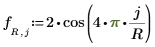
◦ Boundary condition along the edges:


6. Define the Jacobi spectral radius variable r, a real number between 0 and 1.

|
|
This parameter controls the convergence of the algorithm. If you see the error message "too many iterations", then try reducing r.
|
7. Call the relax function:

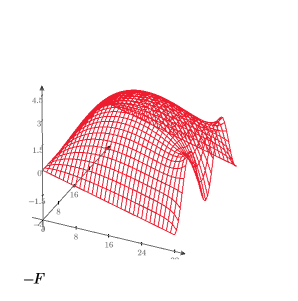
8. Create a 3D plot to show the heat distribution over the square plate.
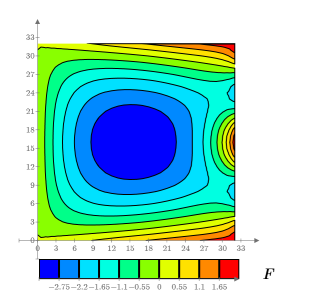
9. Create a contour plot to show the lines of constant temperature.