Cylindrical Spline Surface
The cylindrical spline surface is a nonuniform bicubic spline surface that passes through a grid with tangent vectors given at each point. The grid is curvilinear in modeling space.
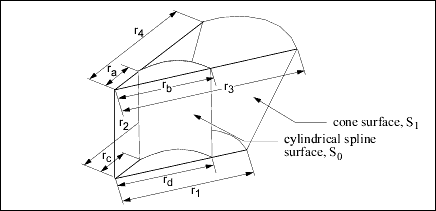
Data Format:
e1[3] x' vector of the local coordinate
system
e2[3] y' vector of the local coordinate
system
e3[3] z' vector of the local coordinate
system, which corresponds to the
axis of revolution of the surface
origin[3] Origin of the local coordinate
system
splsrf Spline surface data structure
system
e2[3] y' vector of the local coordinate
system
e3[3] z' vector of the local coordinate
system, which corresponds to the
axis of revolution of the surface
origin[3] Origin of the local coordinate
system
splsrf Spline surface data structure
The spline surface data structure contains the following fields:
u_par_arr[] Point parameters, in the
u direction, of size Nu
v_par_arr[] Point parameters, in the
v direction, of size Nv
point_arr[][3] Array of points, in
cylindrical coordinates,
of size Nu x Nv. The array
components are as follows:
point_arr[i][0] - Radius
point_arr[i][1] - Theta
point_arr[i][2] - Z
u_tan_arr[][3] Array of u tangent vectors.
in cylindrical coordinates,
of size Nu x Nv
v_tan_arr[][3] Array of v tangent vectors,
in cylindrical coordinates,
of size Nu x Nv
uvder_arr[][3] Array of mixed derivatives,
in cylindrical coordinates,
of size Nu x Nv
u direction, of size Nu
v_par_arr[] Point parameters, in the
v direction, of size Nv
point_arr[][3] Array of points, in
cylindrical coordinates,
of size Nu x Nv. The array
components are as follows:
point_arr[i][0] - Radius
point_arr[i][1] - Theta
point_arr[i][2] - Z
u_tan_arr[][3] Array of u tangent vectors.
in cylindrical coordinates,
of size Nu x Nv
v_tan_arr[][3] Array of v tangent vectors,
in cylindrical coordinates,
of size Nu x Nv
uvder_arr[][3] Array of mixed derivatives,
in cylindrical coordinates,
of size Nu x Nv
Engineering Notes:
If the surface is represented in cylindrical coordinates (r, theta, z), the local coordinate system values (x', y', z') are interpreted as follows:
x' = r cos (theta)
y' = r sin (theta)
z' = z
y' = r sin (theta)
z' = z
A cylindrical spline surface can be obtained, for example, by creating a smooth rotational blend (shown in the figure on the previous page).
In some cases, you can replace a cylindrical spline surface with a surface such as a plane, cylinder, or cone. For example, in the figure, the cylindrical spline surface S1 was replaced with a cone (r1 = r2, r3 = r4, and r1 ≠ r3).
If a replacement cannot be done (such as for the surface S0 in the figure (ra ≠ rb or rc ≠ rd)), leave it as a cylindrical spline surface representation.