Propeller Acoustics Overview
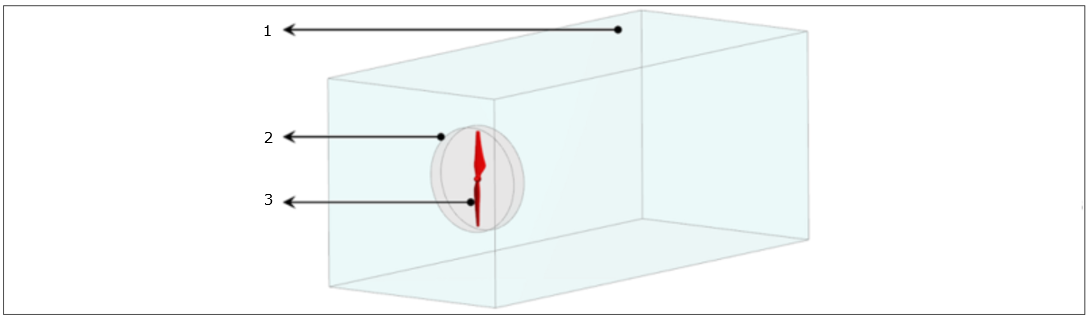
This tutorial demonstrates the aero-acoustic simulation of a propeller. The propeller consists of 2 blades and rotates at 5100 rpm. The propeller is enclosed by an outer domain to perform the external flow simulation. The figure below shows the computational domain with propeller and conditions for the simulation.
The simulations identify the acoustic source and predict the sound level in two projects as described below.
Project 1: Broadband Source model
Steady simulation of propeller is performed using Broadband source model to identify the acoustic source.
Project 2: Ffowcs-Williams Hawkings (FWH) model
Transient simulation is run using the obtained steady state results as initial solution and Ffowcs-Williams Hawkings (FWH) model is used to predict the sound level.
Problem overview- Fuel tank filling
Fluid properties
Air density—1.17kg/m3
Air viscosity—1.85e-05 Pa-s
1. Enclosure
Pressure—0 Pa
2. Propeller MRF zone
3. Propeller
Rotational speed—5100 rpm
Rotational direction—Counterclockwise